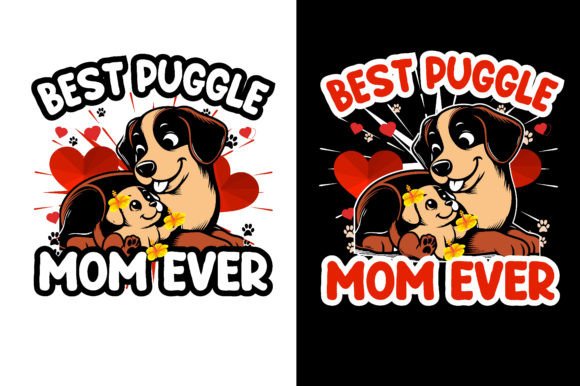
Best Puggle Mom Ever
A Designer’s First Look: Charm, Clarity, and That Instant “Yes” Factor
When Best Puggle Mom Ever landed in my inbox, I paused mid-coffee. Not because it’s flashy or technically complex—but because it *feels* like a real moment captured: warm, slightly playful, quietly proud. As someone who’s digitized over 300 pet-themed embroidery files and shipped embroidered totes to boutique clients across six states, I know how rare it is for a simple graphic to land with this kind of emotional resonance—and still hold up under needle and thread.
Real Project Test: A Custom Embroidered Tote for a Local Dog Rescue Fundraiser
Last week, I used Best Puggle Mom Ever on a natural canvas tote—medium-weight, unbleached, with subtle slub texture. No lining, no interfacing beyond tear-away stabilizer. The result? Clean satin-stitched puggle outline, crisp lettering with just enough weight to read at arm’s length, and zero puckering—even where the fabric dipped near the gusset seam. Customers didn’t just buy the bag; they pointed, smiled, and said, “That’s *me*.” That’s the quiet power of a design that balances personality with precision.
Where It Shines (and Where It Asks for Care)
Best Puggle Mom Ever works beautifully as a machine embroidery design on stable, medium-to-heavy fabrics: cotton twill aprons, fleece-lined sweatshirts, structured pillow covers, and tea towels with tight weaves. Its layout—horizontal, centered, with generous negative space around the puggle’s head and script—gives stabilizer room to do its job and keeps stitch density manageable.
It’s especially strong for personalized gifts and small shop products: think baby onesies (with lightweight cutaway), denim jackets (tested with wooly nylon topping), or embroidered patches sewn onto nursery wall hangings. As a tote bag design, it sits perfectly above the side seam—not too high, not too low—and reads clearly even when the bag is slung over a shoulder.
But here’s where attention matters:
- Thin or stretchy fabric? Skip the lightweight jersey tees unless you’re using a high-quality adhesive stabilizer and reducing top tension. The script’s curves can blur if the base fabric shifts.
- Dark fabric? The design relies on contrast—so test your thread colors early. A charcoal gray puggle on navy feels grounded; white script on black reads sharply, but pale yellow on dark denim fades visually.
- Caps or curved surfaces? The horizontal flow doesn’t wrap well on front panels of structured caps. Save it for back-strap embroidery or flat-panel trucker hats.
- Tiny hoops? Under 4x4 inches, the lettering starts to lose legibility. I recommend minimum 5x7 hoop size for best clarity—especially if you’re selling finished items where detail signals care.
What This Design Says About Your Brand—Without Saying a Word
Using Best Puggle Mom Ever isn’t just about stitching a phrase—it’s about signaling warmth, specificity, and authenticity. Unlike generic “Mom Life” graphics, this one names a breed, leans into gentle humor, and avoids cliché. For an Etsy seller or craft business, that builds instant trust: customers see you understand their world—the muddy paws, the snoring naps, the way a puggle’s squint says more than words ever could.
It elevates a plain sweatshirt from “nice gift” to “thoughtful heirloom.” On a linen kitchen towel, it becomes part of a curated, handmade product—not mass-produced decor. And for holiday embroidery like Mother’s Day, it stands out precisely because it doesn’t shout. It invites a pause, a smile, a nod.
Practical Notes Every Embroidery Designer Should Run Through
Before stitching your first finished product, treat Best Puggle Mom Ever like any professional digital embroidery file:
- Test on scrap fabric—same weight, same dye lot, same wash history as your final piece.
- Check thread color contrast in natural light *and* under warm bulb lighting. What reads bold at noon may soften by evening.
- Review stitch density in your editing software. If fill areas look overly dense (especially inside the puggle’s ear), consider reducing density by 5–8% for breathable fabrics.
- Confirm hoop size compatibility—don’t assume “standard” fits your machine’s max width. Measure the design’s bounding box, not the preview thumbnail.
- Inspect small details: the curve of the puggle’s jowl, spacing between “Puggle” and “Mom,” the tail’s taper. These define polish.
- Mock it up in black and white first—many buyers visualize monochrome before choosing colors.
- Compare light vs. dark backgrounds using printable mockups. A design that pops on ivory may disappear on oatmeal.
- Use proper stabilizer: tear-away for stable wovens, cut-away for knits, and always test topping (like water-soluble film) on textured fabrics.
- Verify licensing before listing as a digital embroidery file or selling stitched goods commercially. Since the description notes these are Graphics usable for printing on fabric, confirm whether commercial embroidery rights are included—or if separate permission is needed.
Final Thought: Not Just a Design—A Conversation Starter
Best Puggle Mom Ever doesn’t try to be everything. It’s not a sprawling applique design with layered fabrics or 3D puff effects. It’s a focused, confident statement—clean enough for modern boutiques, heartfelt enough for handmade gifting, and versatile enough to anchor a collection of holiday embroidery assets. Whether you’re prepping for Mother’s Day orders, building a pet-lover capsule line, or refreshing your small shop product lineup, this design earns its place not through novelty, but through quiet reliability and genuine charm.