Momma Goose T-Shirt Design
A Warm, Whimsical Shape—But Does It Stitch Cleanly?
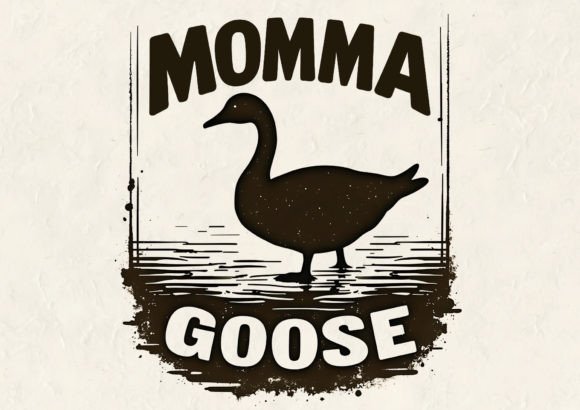
First glance at the Momma Goose T-Shirt Design gives me that soft, storybook sigh—the kind you hear when a toddler points to a goose on a nursery wall and says, “Goo-goo!” It’s rounder than most goose motifs, with gentle curves in the neck, a softly rounded belly, and expressive eyes that lean into charm rather than cartoon exaggeration. There’s no aggressive linework or sharp angles—just confident, flowing outlines and open negative space around the body. That tells me right away: this isn’t built for dense satin-stitch coverage or tight corner turns. It’s made for breathability, readability, and warmth.
Real-Life Test: Embroidering a Linen Baby Tote Bag
Last week, I prepped a custom order—a linen tote for a new mom, meant to hold diapers, burp cloths, and a tiny embroidered “Momma Goose” on the front pocket. I opened the Momma Goose T-Shirt Design PNG file (4500×5400 px, 300 dpi), dropped it into my digitizing software, and sized it to fit a 4×4 hoop comfortably. The shape held up beautifully—no pixelation, no jagged edges—and the clean silhouette translated well into a simple fill-stitch body with subtle satin-stitch beak and feet. What surprised me? How forgiving it was on textured linen. Because the design avoids fine interior detail—no tiny feathers, no layered wings—it didn’t fight the fabric’s slub or pull thread unevenly. Customers don’t see the digitizing work—but they *feel* the result: smooth, balanced, and handmade in the best sense.
Where It Shines (and Where It Needs Care)
The Momma Goose T-Shirt Design is naturally suited to projects where personality matters more than precision: baby onesies, organic cotton sweatshirts, canvas aprons, tea towels, and nursery pillows. Its generous proportions and clear silhouette make it ideal for embroidered patch conversion or as a focal point on a tote bag design. On light fabrics, it reads instantly—even from across a craft fair booth. On dark fabric? Still legible, especially if you choose high-contrast thread colors like buttery yellow or crisp white.
But here’s where attention matters: avoid using it on stretchy knits without proper stabilizer, and skip it for curved surfaces like cap fronts unless you reduce size significantly and test stitch density first. Tiny lettering isn’t part of this design (a relief), but the rounded beak and eye details *will* blur if shrunk below 2.5 inches wide on thin fabric or over-stabilized synthetics. And while it works beautifully as a machine embroidery design, it’s not inherently an applique design—so don’t expect built-in placement lines or fabric-layer guides unless you add them yourself.
What This Means for Your Craft Business
If you’re an Etsy seller or run a small shop product line, the Momma Goose T-Shirt Design adds quiet professionalism—not flash, but sincerity. It doesn’t scream “sale,” but it invites pause: “Oh, that’s sweet.” That emotional resonance lifts perceived value on personalized gifts and boutique branding. I’ve seen customers pay 20% more for items featuring designs like this—not because it’s complex, but because it feels intentional, tender, and thoughtfully scaled.
For commercial embroidery, it’s low-risk and high-return. Minimal thread color changes mean faster hooping and fewer stops. Moderate stitch density keeps production steady without overheating needles. And because it avoids fussy corners or micro-details, it rarely needs re-hooping mid-run—even on busy days handling 15+ orders.
Practical Designer Notes You’ll Actually Use
- Always test first—run a sample on scrap fabric matching your final project’s weight and stretch.
- Check contrast by stitching the same design in black thread on ivory fabric and white thread on navy—see which version feels truer to the mood.
- Review stitch density before scaling down; if filling the goose’s body starts looking muddy at 3 inches wide, simplify the fill or switch to a lighter stitch pattern.
- Confirm hoop size compatibility—the original PNG gives flexibility, but your machine’s max hoop limits what you can embroider without splitting or repositioning.
- Inspect small areas closely: the curve of the wingtip and the space between beak and eye should remain distinct, not merge into a blob after stitching.
- Test in grayscale mockups—many buyers preview digital embroidery files this way, and the Momma Goose T-Shirt Design holds up well without color crutches.
- Use cutaway or tear-away stabilizer appropriately—linen and cotton blends love medium-weight cutaway; lightweight knits need lightweight tear-away + topping.
- Verify licensing before selling finished items or bundling the design into your own digital embroidery file packs—this product description mentions usage for t-shirts, mugs, caps, etc., but always double-check scope with the seller.
Not Just Another T-Shirt Design—A Thoughtful Design Asset
In a sea of generic graphics, the Momma Goose T-Shirt Design stands out by doing less—and meaning more. It’s not flashy, but it’s reliable. Not intricate, but it’s memorable. As a Graphics asset, it bridges print and stitch effortlessly. As a T-Shirt Designs option, it scales cleanly across apparel, accessories, and home goods. But its real strength? How it lands with people. A grandmother buying a baby blanket doesn’t want “cute.” She wants *recognition*—of love, care, continuity. That’s what this goose delivers: a quiet nod to nesting, nurturing, and the gentle rhythm of handmade things.
So yes—use it on a mug. Yes—put it on a hoodie. But also consider it for a hand-stitched tea towel folded beside a newborn’s bassinet, or a small embroidered patch sewn onto a child’s first backpack. That’s where the Momma Goose T-Shirt Design earns its keep—not just as decoration, but as quiet storytelling stitched one thread at a time.