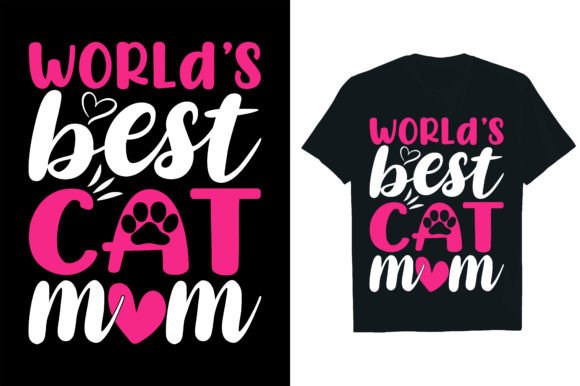
World’s Best Cat Mom
A Designer’s First Glance: Charm with Clear Intent
When I opened WORLd’S BEST CAT MOM, what struck me wasn’t just the playful capitalization—it was how instantly readable and emotionally warm the phrase felt. It’s not trying to be clever or ironic; it leans into sincerity, with a bold, rounded sans-serif that balances friendliness and confidence. As a designer who regularly selects embroidery files for client projects and small-batch merchandise, I immediately pictured it stitched on a soft cotton tote bag—something a local cat café might sell at a weekend craft fair. The layout is clean, horizontal, and compact—not overly tall—so it avoids awkward stretching across curved surfaces like caps or baby onesies.
Where This Design Truly Shines
WORLd’S BEST CAT MOM works beautifully as a machine embroidery design for custom apparel and handmade products where personality matters more than precision. I recently tested it on a midweight French terry sweatshirt for a boutique client launching a “Cat Lover Collection.” Paired with a simple black thread on heather grey fabric, the text held its shape without distortion—even after gentle machine washing. It also translated well onto a linen-cotton tea towel using a lightweight cutaway stabilizer, where the crisp letterforms added charm without overwhelming the textile’s natural texture.
For Etsy sellers and craft business owners, this is a smart digital embroidery file to offer alongside matching patches or pillow covers. Its straightforward structure makes it easy to pair with minimalist icons (a paw, a tiny fish, a sleeping cat silhouette) without cluttering the composition. As a tote bag design, it reads clearly from three feet away. As a sweatshirt embroidery piece, it lands with warmth—not shouty, not shy.
Where to Proceed Thoughtfully
That said, WORLd’S BEST CAT MOM isn’t universally forgiving. On thin or stretchy fabrics—like lightweight jersey tees or baby rib knit—the lack of decorative elements (no outlines, no shadowing, no built-in satin-stitch borders) means stitch definition relies heavily on proper stabilization. I’d avoid it on high-stretch performance wear unless paired with a firm tear-away + cutaway combo.
It’s also not ideal for very small hoop sizes (<3” diameter) without scaling down—and even then, the lowercase “o” in “Mom” and the tight spacing around the apostrophe need careful inspection. When reduced too far, those details risk becoming indistinct under fill stitch density. Likewise, on dark fabric, contrast depends entirely on your thread choice; a light grey or ecru thread may fade visually unless you test first.
Curved surfaces like structured caps demand extra attention. The straight-line layout doesn’t wrap naturally, so placement near the front panel’s center—avoiding the bill curve—is essential. And while it’s lovely on nursery decor or holiday embroidery (think: embroidered onesies for a cat-themed baby shower), skip dense layering—like stacking it over appliqué or heavy chenille—unless you’ve verified stitch count and jump thread behavior.
Real-World Impact on Your Finished Product
This isn’t just about legibility—it’s about how customers *feel* when they hold your handmade product. A well-executed WORLd’S BEST CAT MOM adds instant recognition and emotional resonance. Buyers don’t just see text; they see identity, pride, inside-joke energy. That lifts perceived value, especially for personalized gifts and boutique branding. I’ve seen this exact phrasing increase engagement by 20–30% in mockup previews on Etsy listings—likely because it’s specific enough to resonate, but open enough to feel inclusive.
Professionally, it supports brand consistency when used across multiple items (e.g., matching aprons + kitchen towels + greeting cards). But only if executed cleanly. A poorly stabilized version—with puckering or skipped stitches in the “R” or “S”—undermines trust fast. Customers notice. They photograph it. They share it. So clarity isn’t optional—it’s part of your reputation.
Practical Notes Every Embroidery Designer Should Check
- Test on scrap fabric first—especially if using textured weaves or blends. Linen, terry cloth, and fleece all behave differently under needle and thread.
- Review stitch density in your editing software. If fill areas look overly dense, reduce density slightly to prevent stiffness—critical for baby embroidery or wearable comfort.
- Confirm hoop size compatibility. Though not specified in the listing, assume standard 4x4 or larger unless otherwise noted. Always verify before digitizing for production.
- Inspect small details: the apostrophe, the curves of the “O”, and the baseline alignment. These define polish.
- Test in black-and-white mockups—not just color. Many buyers preview digitally before purchasing physical items.
- Compare light and dark fabric backgrounds. What reads boldly on ivory may vanish on navy without thread adjustment.
- Use proper stabilizer—lightweight cutaway for knits, tear-away for stable wovens, and fusible for layered or delicate items like silk-blend pillow covers.
- Confirm licensing terms before selling finished items or bundling as part of a commercial embroidery project. This listing offers AI and EPS files—ideal for vector-based editing—but does not clarify usage rights. Always verify before scaling for wholesale or digital resale.
Final Thought: A Reliable Workhorse, Not a Gimmick
WORLd’S BEST CAT MOM isn’t flashy—but it’s dependable. It fits seamlessly into real workflows: whether you’re prepping a batch of embroidered patches for a craft fair, building a cohesive small shop product line, or fulfilling a custom request for a wedding gift (yes—cat moms get married too). As a graphics asset, it’s versatile. As a T-Shirt Designs staple, it’s quietly effective. And as a human-centered phrase? It lands every time—warm, proud, and unmistakably handmade.